

Article Sidebar
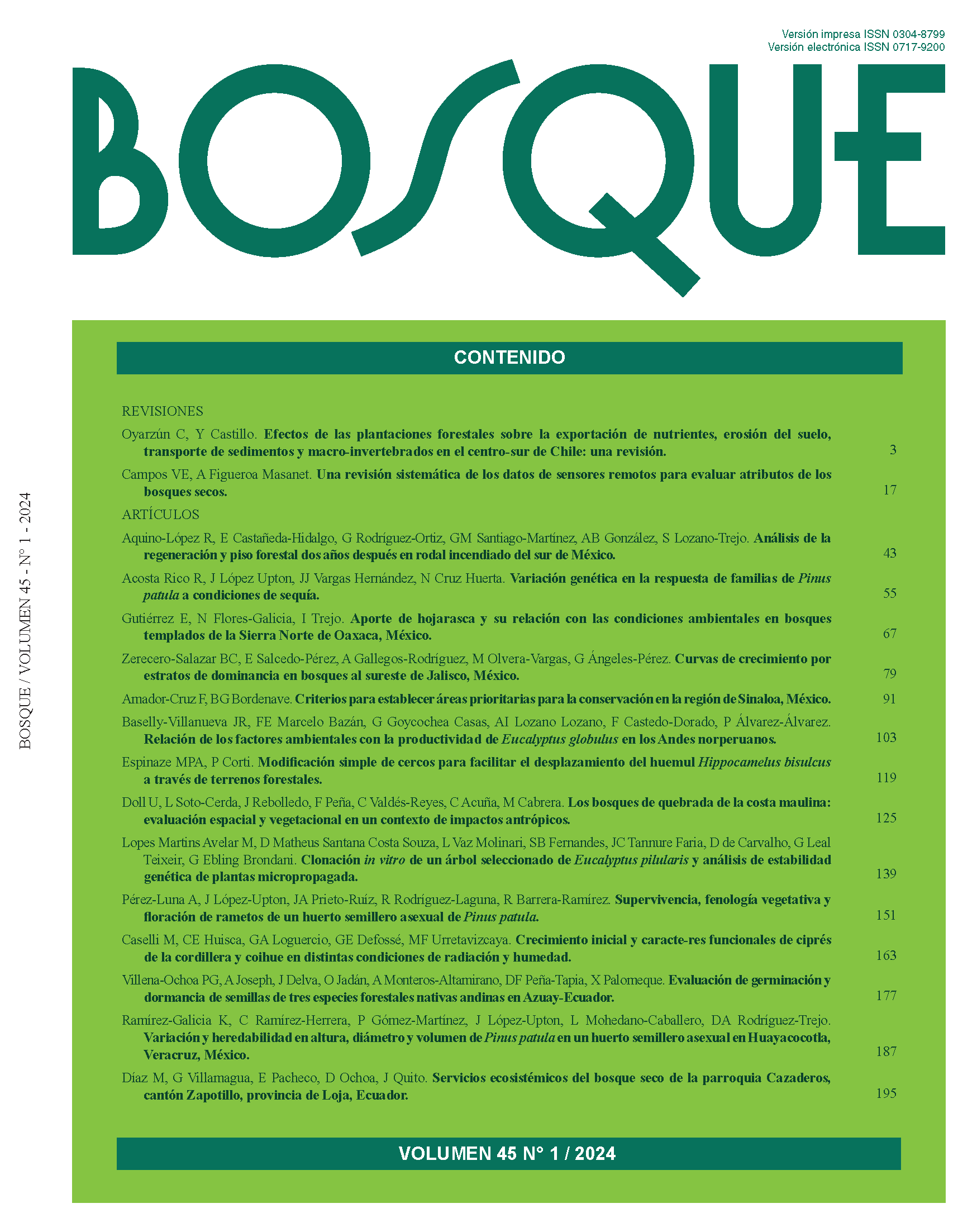
Main Article Content
Jun 4, 2024
Abstract
Ecological indicators are widely used to assess vegetation attributes and can be quantified through field-based and/or remote sensing data. Particularly, advances in remote sensing have allowed monitoring of dry forest attributes across multiple spatiotemporal scales. The objectives were to analyze the recent state-of-the-art in using remote sensing data as ecological indicators to assess dry forest attributes; identify the data source of remote sensing indicators used; and identify the geographical distribution of these studies. A systematic search was conducted for original research articles that used remote sensing data as ecological indicators of dry forests attributes. Composition indicators were assessed with the same frequency at species/population and landscape/region hierarchy levels. However, structural indicators were mainly assessed at the species/population level, and function indicators at the community/ ecosystem level. Over 60 % of the articles considered one ecological indicator, 20.45 % two, and 18.18 % used three indicators. Over 47 % considered field surveys and remote sensing data to assess dry forest attributes, and more than 52 % only had remote sensing data. Four out of the 88 articles analyzed report a weak relationship between field surveys and remote sensing data. Landsat and MODIS products were the most frequently used, with South America being the most studied continent. Observations and products from a single sensor, as well as using only one ecological indicator or one hierarchy level, would not be enough to represent the complexity of dry forest ecosystems.
Downloads

This work is licensed under a Creative Commons Attribution-NonCommercial 4.0 International License.