
Article Sidebar
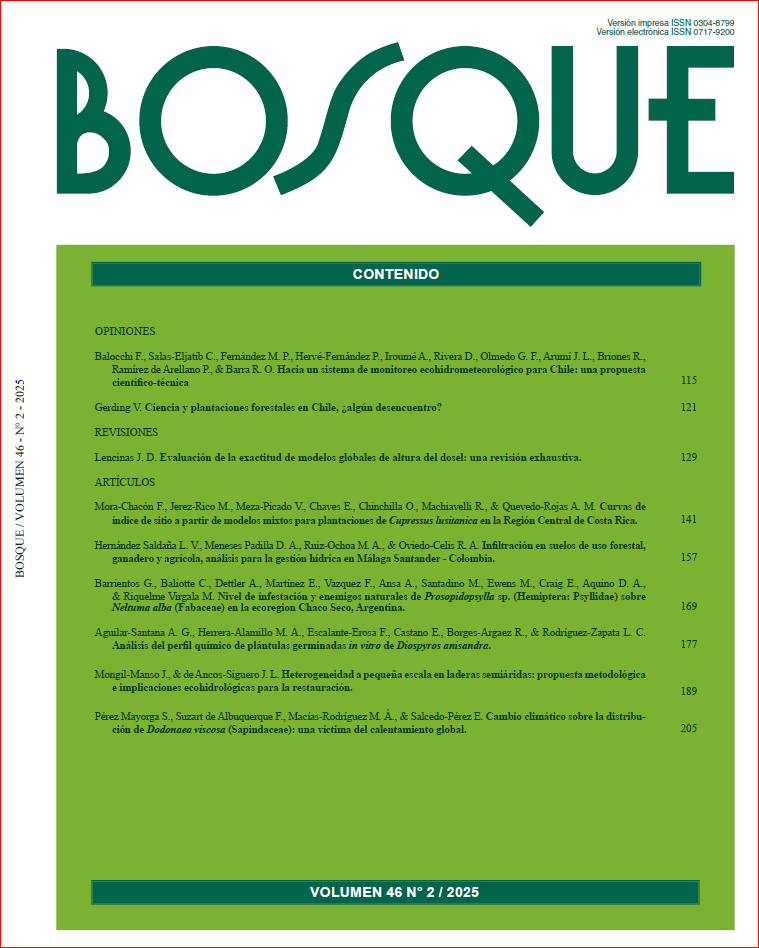
Main Article Content
Sep 11, 2025
Abstract
The native species Neltuma alba is promoted in the Chaco Seco ecoregion for its forestry, timber and ethnobotanical potential. Prosopidopsylla is a genus of insects that develops mainly on Neltuma spp., causing malformations in leaves and their subsequent fall. Due to the value of N. alba, the aims were to evaluate the incidence and severity of Prosopidopsylla sp. and record its main natural enemies. The study was carried out at the Fernández Experimental Station, Santiago del Estero, Argentina. According to the phenology of the trees, branches of cloned plants from four origins were collected. The abundance of psyllids and its ovipositions as well as the damage were recorded, to calculate the incidence (proportion of leaves on which they were present) and severity (number of specimens or associated damage per leaf). In addition, the abundance of predators, and parasitized immatures were recorded. The results demonstrate that there is a synchronization of the activity of the psyllids with the phenology of N. alba, with the bloom period being the most favourable for the development of these insects; there is a differential susceptibility among the different origins of the clones; the region has a variety of predators and parasitoids with the potential to regulate the Prosopidopsylla sp. population, the main ones being Orius sp., Zelus renardii and Psyllaephagus sp. The information presented in this work constitutes a basis for the management and selective improvement for N. alba resistance against Prosopidopsylla sp. and the promotion of its biological controllers in the Chaco Seco ecoregion.
Downloads

This work is licensed under a Creative Commons Attribution-NonCommercial 4.0 International License.