

Article Sidebar
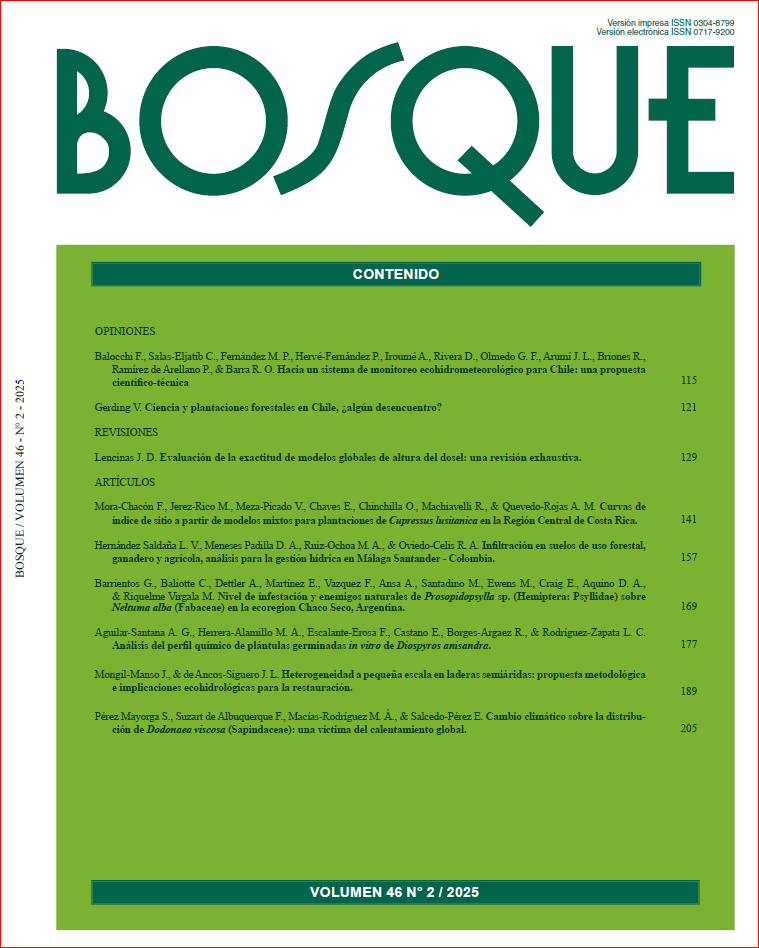
Main Article Content
Sep 11, 2025
Abstract
The forestry model with plantations that has been imposed in Chile is characterized by allowing and promoting extensive, even-aged, monospecific plantations with simple management based on successive rotations and clear-cutting. These plantations have generated various benefits, but have also entailed environmental and social problems. Nevertheless, such conflicts could have been avoided if the fundamentals of forestry science had been respected. For several decades in Chile (and earlier in other regions of the world), scientists have generated and published information on managing ecologically, economically, and socially appropriate forestry options; they have also warned about potential consequences of not applying it. However, such scientific information has not been fully considered, even in the current forestry policy, and there are still problems in plantations that denote a poor application of science. The insufficient application of these sciences in forest plantations, its possible causes, and some possible solutions are discussed. Forest plantations require the application of the pertinent scientific foundations and increased research for their continuous improvement. Scientific knowledge must be promoted in all scenarios of society and avoid being trapped in the scientists’ circuit. It is proposed to especially strengthen the interaction of science disseminators with decision-makers in public and forestry policies.
Downloads

This work is licensed under a Creative Commons Attribution-NonCommercial 4.0 International License.