

Article Sidebar
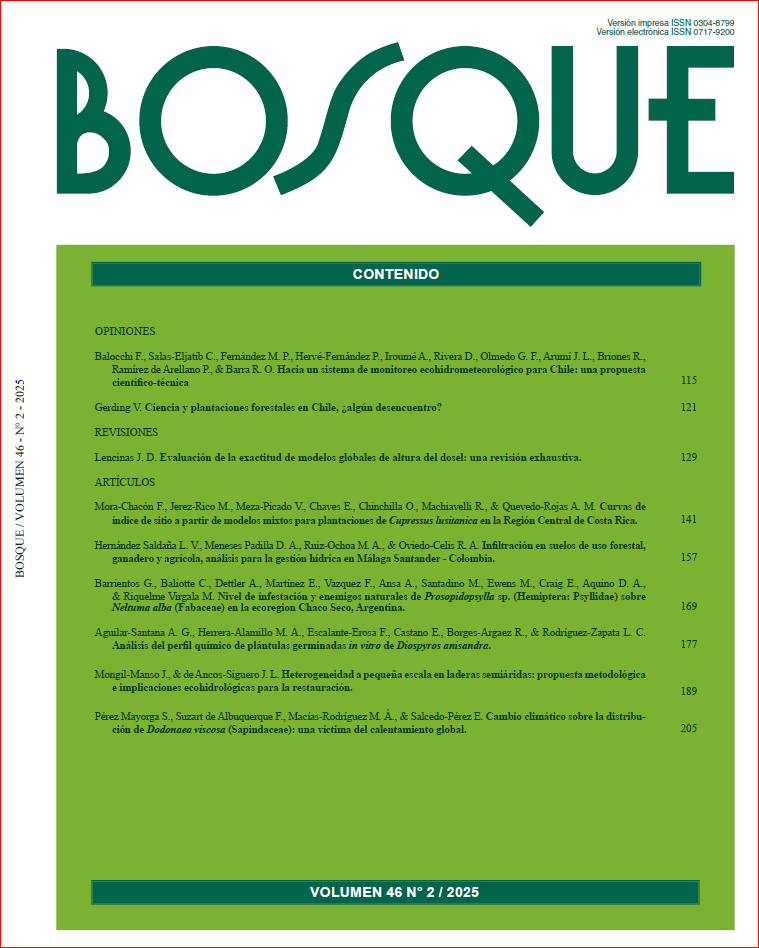
Main Article Content
Sep 11, 2025
Abstract
When engaging in ecological restoration, it's crucial to assess the status of ecological processes in terms of functionality or dysfunctionality to properly plan restoration efforts. In this regard, the EFA/LFA methodology proves highly beneficial as it employs a set of ecohydrological indicators based on the small-scale heterogeneity of semi-arid slopes. This methodology operates on the premise that highly functional ecosystems effectively retain essential resources like water, soil, nutrients, and organic matter, while declining functionality leads to a progressive loss of these vital resources. The aim of this study is to propose a modification to the sampling technique used in the aforementioned methodology. While the original method suggests sampling via linear transects, this research advocates for surface sampling, which provides a more thorough and precise assessment of the ecological functionality of slopes. To compare both methodologies, statistical tests such as Student's t-test, Mann-Whitney U test, and ANOVA were employed. The results indicate significant differences (p<0.05) in all variables between the original linear or unidimensional sampling method and the proposed surface or bidimensional method. Furthermore, it can be concluded that the application of both methodologies is independent of the sampling area and the degree of ecohydrological functionality.
Downloads

This work is licensed under a Creative Commons Attribution-NonCommercial 4.0 International License.